The History of the Maltese Blood Transfusion and blood banking dates back to the 1930’s, not long after blood transfusion was discovered, were the principals and practicalities of blood storage were worked out (Contemporary Medicine in Malta, 2005).
1930-1931
First 3 blood groups recorded at the Central Civil Hospital, which was situated at Floriana.
1934-1935
During this year 14 blood groups were performed.
1934
During this year, blood grouping started to be used for Blood Transfusion in dangerous cases of haemorrhage. Standard types of known sera were always kept in stock and the matching of blood was consequently made more quickly, thus avoiding harmful delay to the patient. The majority of blood donors were relatives of patients but others, namely students attending the hospital for practice, who volunteered, were accepted.
1935-1936
During this year 66 blood groups were done.
A Blood Transfusion Service was started this year, applications from those wishing to volunteer had been invited by a Government Notice published on the Government Gazette on the 29th November, 1935, which stated:-
‘Persons, male and female who are prepared to offer their blood for transfusion in certain cases of great urgency at the Central Civil Hospital are requested to communicate with the Superintendent of the hospital, who will furnish all information that may be required in connection with this service.’
Office of the Charitable Institutions F. Mercieca
Valletta. 29th November, 1935 Comptroller of Charitable Institutions.
1937
There was an amalgamation of the charitable Institutions with the Public Health Sector.
During this year, a scheme to make blood available was proposed, but it failed due to lack of donors. Occasionally donors were provided from amongst students, the patients’ relatives being in most cases reluctant to play this role. Dr. J. Ellul, Acchoucher and Gynaecologist, continues to say that ‘something more practical should be done to have donors at hand in cases of emergency, as obstetric cases usually are, and as the second highest portion of mortality was due to acute anaemia from severe haemorrhage, were in these cases immediate blood transfusions would have been really beneficial and thus would lower the death rate’.
1938
The below shows blood groups carried out during the mentioned year at the clinical lab at the Central Hospital, Floriana
Type I -2; Type III – 36
Type II – 17; Type IV – 2
1939
Blood Transfusion
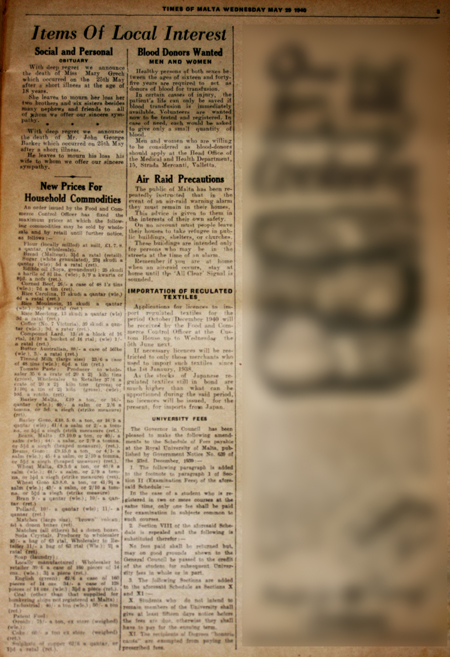
‘Lists of volunteers for blood transfusion are ordered to be maintained in all ships and establishments and the men concerned will have a blood test so that they may be grouped according to their suitability. In common with the practice in civil life and the army, no money payment will be made, but naval donors of blood will on each occasion be granted 48hours leave, which may be prolonged if necessary at the discretion of the Medical Officer’, (Times of Malta, 5th June, 1939).
1940
Second World War. On the 28th May, 1940 a blood bank was established at Bugeja Hospital (previously the Bugeja Private Technical Institute), which used to form part of Hamrun. During this time, blood transfusions were made of whole blood but dried plasma reached our shores very soon after it was released in Britain and was found useful and effective in suitable cases.